🔬 Got a phone? You've got a microscope. Try JAIMS Explorer FREE →
The Critical Role of MRO Inspection in Aerospace
An insight into why repeatable, high-precision inspection is critical in aerospace MRO, exploring how OEMs balance fast shop-floor decisions with nanometre-level measurement to protect safety and high-value components.
Jamie Greatrix | Founder & Director of JAIMS
12/17/20252 min read
The Critical Role of MRO Inspection in Aerospace
Why Repeatable Defect Measurement Protects Both Value and Safety
In aerospace, Maintenance, Repair and Overhaul (MRO) inspection is not a secondary process. From an OEM perspective, it is one of the most critical decision-making stages in the entire lifecycle of an engine or component.
For manufacturers such as Rolls-Royce, MRO inspection directly determines whether a high-value part can safely return to service, be reworked, or must be scrapped. These decisions are safety-critical, commercially significant, and must be made with absolute confidence.
Defect Measurement Drives the Decision
In MRO environments, many components, particularly turbine blades, blisks, and hot-section parts, return from service with surface damage. Scratches, nicks, dents, and material loss are expected realities of operation.
The key question is never whether a defect exists, but:
How deep is it?
How does it relate to allowable limits?
Can the part be safely repaired without compromising performance or life?
These decisions are governed by extremely tight tolerances. In many cases, the difference between rework and scrap is measured in microns, or even nanometres.
When a single blade can be worth tens of thousands of pounds, and an assembled module far more, the importance of accurate defect measurement cannot be overstated.
Speed vs Certainty on the Shop Floor
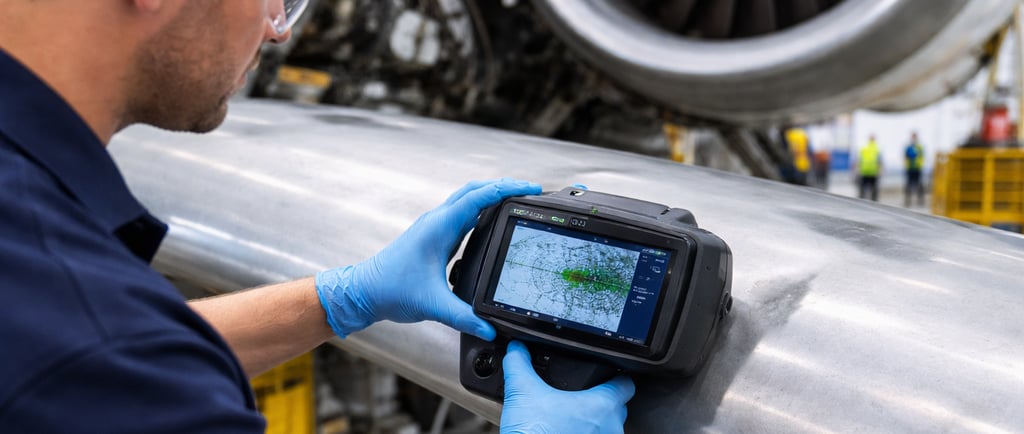
Modern MRO operations require fast, informed decisions to maintain throughput and minimise engine downtime. This is why tools such as GelSight are increasingly used on the shop floor.
Gel-based tactile imaging provides rapid, high-contrast surface visualisation and allows inspectors to quickly assess defect shape and severity. It is an excellent tool for triage and first-pass decision-making.
However, speed alone is not enough.
For final accept/reject or repair decisions, especially where defects approach critical limits, OEMs still rely on traceable, high-precision measurement techniques.
Why Replica Methods Still Matter
Despite advances in digital inspection, replica compounds such as Plastiform and similar materials remain widely used in aerospace MRO.
The reason is simple: they allow complex surface defects to be:
Captured accurately
Removed from the shop floor
Measured in controlled laboratory conditions
Once cured, replicas can be analysed using high-end optical profilers and non-contact surface measurement systems capable of nanometre-level vertical resolution.
This approach provides:
Exceptional measurement accuracy
Traceable, auditable data
Confidence in borderline decisions
From an OEM perspective, this additional step is not inefficiency, it is risk control.
The Importance of Repeatability and Correlation
One of the biggest challenges in MRO inspection is ensuring consistency between:
Shop-floor inspection tools
Laboratory measurement systems
Different sites and operators
A defect measured on the engine stand must correlate with results from the lab. Any mismatch introduces uncertainty, delays, and the potential for conservative decisions that unnecessarily scrap valuable parts.
This is why OEMs invest heavily, often millions in:
Validated measurement workflows
Correlation studies between systems
Calibration and verification routines
Operator training and standardisation
Repeatability is as important as accuracy. Without it, even the most precise measurement system loses value.
Safety, Value, and Reputation Are Interlinked
For an OEM, MRO inspection is not only about cost control. It is about protecting:
Flight safety
Asset value
Brand reputation
Regulatory confidence
Releasing a component that should have been scrapped is unacceptable. Equally, scrapping a component that could have been safely repaired has significant financial and environmental implications.
This balance, between safety and value, is why inspection and measurement capability in MRO is treated as a strategic investment, not a support function.
Final Thoughts
From an OEM manufacturer’s perspective, aerospace MRO inspection sits at the intersection of engineering precision and operational responsibility.
Fast shop-floor tools enable efficient decision-making, while high-precision laboratory measurement provides the certainty required for safety-critical judgments. Both are essential, and both must work together within a validated, repeatable inspection framework.
When tolerances are tight, parts are valuable, and safety is non-negotiable, inspection is not just a process, it is a cornerstone of aerospace integrity.
Contact
Questions? Reach out for tailored advice.
Phone
© 2026. All rights reserved.
Company Number: 16933717
Follow us!