🔬 Got a phone? You've got a microscope. Try JAIMS Explorer FREE →
How AI Is Enabling Faster, More Confident Decisions in Optical & Digital Microscope Inspection
How AI-powered inspection software is reducing subjectivity and enabling faster, more confident decisions in optical and digital microscopy.
Jamie Greatrix | Founder & Director of JAIMS
12/17/20252 min read
How AI Is Enabling Faster, More Confident Decisions in Optical & Digital Microscope Inspection
Optical and digital microscopes have been used in manufacturing for decades, but the way inspection decisions are made is changing rapidly. The biggest shift isn’t in optics or illumination, it’s in software.
AI-driven inspection tools are now helping operators make faster, more consistent, and more confident decisions, particularly in environments where parts are complex, tolerances are tight, and throughput matters.
From Subjective Judgement to Consistent Decisions
Traditional microscope inspection often relies heavily on operator experience. Two skilled inspectors can look at the same image and still reach slightly different conclusions, especially when defects are subtle or borderline.
AI software helps remove that variability.
By training algorithms to recognise acceptable features, defects, and process variations, inspection decisions become:
More repeatable
Less dependent on individual judgement
Easier to standardise across shifts and sites
This doesn’t replace the operator, it supports them with a consistent reference point.
Faster Decisions Without Compromising Quality
One of the biggest benefits customers are seeing is speed.
AI-assisted inspection can:
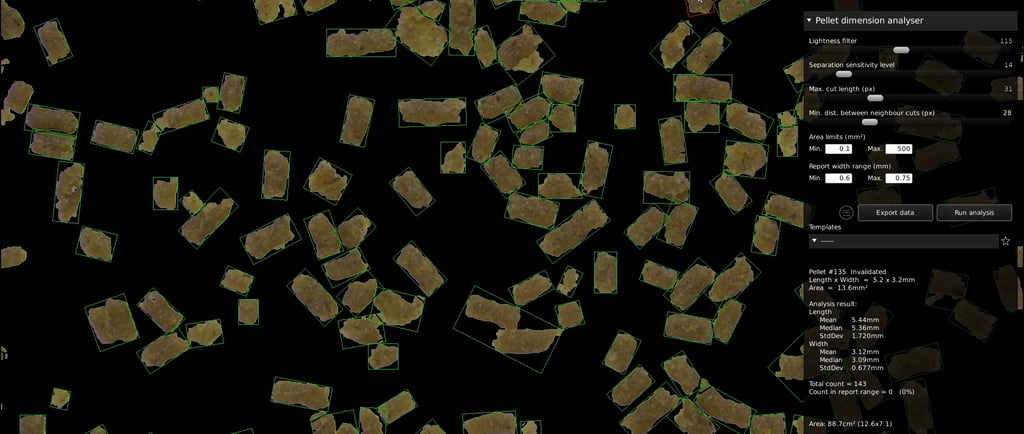
Automatically highlight areas of interest
Flag defects in real time
Reduce the time spent reviewing images
For high-volume or time-critical environments, this means faster pass/fail decisions without sacrificing accuracy. Operators spend less time searching for issues and more time validating results.
Localised vs Cloud-Based AI Training
Modern AI inspection platforms generally fall into two approaches: localised (on-premise) and cloud-based training.
Localised AI training allows manufacturers to:
Train models directly on their own systems
Keep sensitive data on site
Fine-tune inspection criteria for specific parts or processes
This is particularly attractive in regulated or IP-sensitive industries.
Cloud-based AI training offers different advantages:
Faster model improvement using larger datasets
Easier deployment across multiple sites
Continuous learning as new defect types are identified
In practice, many manufacturers adopt a hybrid approach, training locally for control and validation, while using cloud tools to accelerate learning and standardisation.
Improved Accuracy Through Better Data, Not Just Better Algorithms
AI inspection doesn’t become accurate overnight. Its real strength comes from structured, well-labelled data.
As more images are captured and validated:
False positives reduce
Borderline decisions become clearer
Inspection confidence increases
Over time, this leads to measurable improvements in yield, reduced rework, and fewer escaped defects.
Supporting Operators, Not Replacing Them
A common concern is that AI removes human involvement. In reality, the most successful implementations use AI as a decision-support tool, not a replacement.
Experienced operators:
Validate AI results
Refine training sets
Provide context when anomalies occur
The result is a more capable inspection process, not a less skilled workforce.
What This Means for Manufacturers
For manufacturers using optical and digital microscopes, AI-enabled inspection offers:
Faster inspection cycles
Greater consistency across operators and sites
Improved confidence in inspection outcomes
A scalable path as products become smaller and more complex
The key is choosing software that fits the application, the regulatory environment, and the organisation’s appetite for change.
Contact
Questions? Reach out for tailored advice.
Phone
© 2026. All rights reserved.
Company Number: 16933717
Follow us!